The media was effective in some aspects of Hurricane Katrina.
To first begin, the media was extremely resourceful in finding survivors and helping families find a lost family member. Highlighting the issues that impacted the poorer residents in New Orleans before and after Hurricane Katrina. Even showing that pets deserved to be part of the evacuation process.
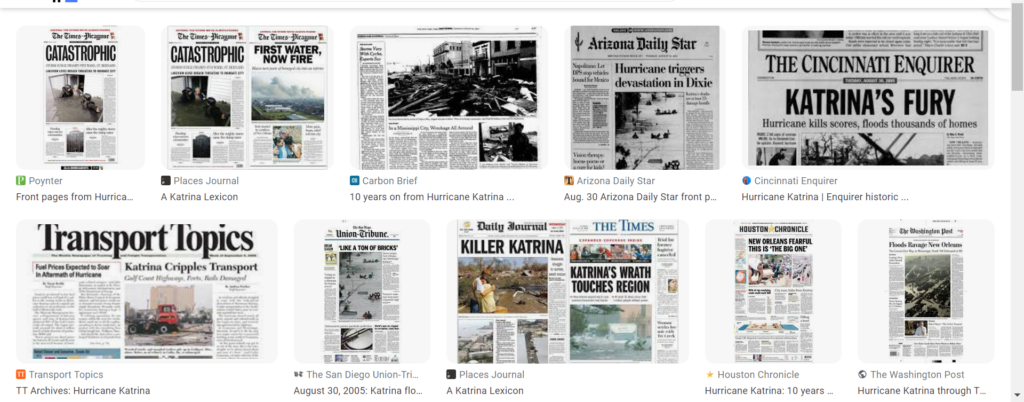
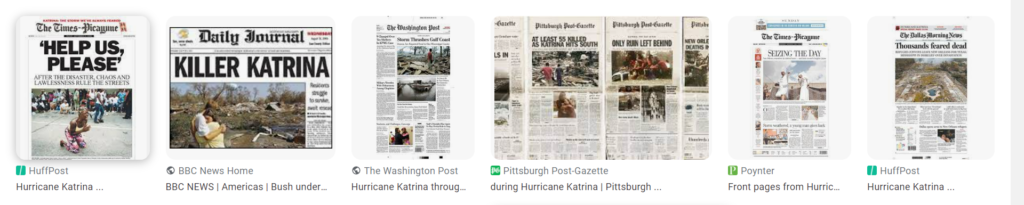
During and after Hurricane Katrina, the media was invoking the use of emotion to tract national attention to Hurricane Katrina. As I would search Hurricane Katrina articles on the Google Search engine, the screenshots below are what appeared as the first results. There are some words used to invoke a sense of emotion, such as catastrophic, help us, Katrina’s wrath, killer Katrina. Common negative words that would bring attention to the issue, and to create an image of a community that needed help. However successful stories also invoke hope, relief and healing to the rest of the nation as well.
How has the media negatively affected the image of survivors?
The media has involved the use of yellow journalism, failure to fact-check and use of language on certain topics. Since the hurricane has severely hindered the accessibility of communication, some media outlets conducted journalism without fully verifying the accurateness of the reports.
The death toll of Hurricane Katrina is currently estimated to be at least 1,200 according to the National Oceanic and Atmospheric Administration (NOAA). Although most would say that the death toll is currently at 1,800+. The number is by the identified and found bodies that were recovered, and does not include any bodies either unidentified or missing so the actual number may be uncertain. However, at the time of reporting, some news stations have a different sense of the death toll, as their number slightly varied from each other. Along with Ray Nagin, mayor of New Orleans at the time assumed the death toll was.
Although the numbers are close to each other, there seems to be no true accord as to how many deaths were accurately reported. Especially taking a look at WSAV, the numbers are low compared to the rest of the others. How did exactly the news station came to the conclusion that 1,200 died during Katrina? These numbers were confirmed to be for the entirety of the United States, not solely Georgia. Ray Nagin himself despite being mayor the area most affected by Hurricane Katrina being able to receive reports, has estimated that a whopping 10,000 could be dead. According to him, this was based off computer models and that he himself thought that the death toll would be huge.
Another example is the use yellow journalism. Yellow journalism is described as presenting news with little to no valid information and use exaggeration and sensationalism as said by Oxford Dictionary. Keeping this in mind, look at the Fox News clip as reported by Geraldo Rivera and Shepard Smith. Notice the tone of both men, the use of words and how Rivera questioned Michael Brown the director of FEMA. As they are talking, they are using footage of severe floodwaters and using a woman and her child as victims of incompetence. Notice how they show other survivors at nearby shelters. Also take a look as to how the interviewees were presenting themselves as well. They are using the appeal of language to show how hard they have tried their best to minimize the damage of Hurricane Katrina.
What were some parts of the video that stick out to you?
A look at race as well.
The language of the media is important in every aspect of topics that they cover. However, the media has placed a negative racial bias when it came to reporting certain situations. Take a look at one infamous photo caption comparison below:
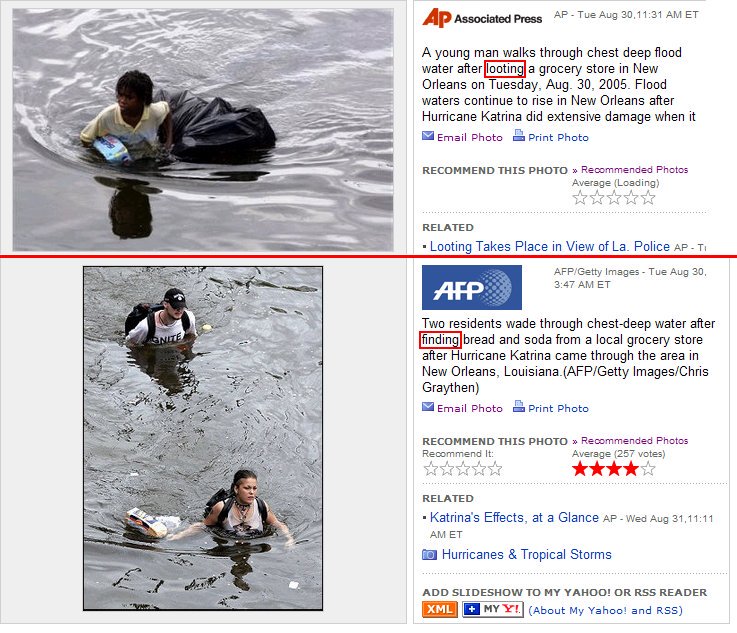
These two photos are captioned by two different news companies. In the top photo, we can see a black person, either a teenager or young adult trudging through the waters carrying what appears to be a trash bag. He seems to have a face of urgency and worry. Captioned by Associated Press, he is described as a looter carrying a bag from a grocery store. In the bottom photo, we see two white individuals also trudging through the waters. They are carrying backpacks, while the woman carries a bag of bread and soda. Agence France-Presse described this photo as two individuals finding food from a grocery store as well.
It is the most infamous example of language being used completely different in context for people of different race. There is no context given as to how the photographers themselves see it happen. Did one of them see a young man walking with a bag and assumed that he looted? Or was the young man looking for any food that he and his family are in desperate need of? Did the other see two individuals desperately looking for food and grabbing what they find to continue? Or did they stole it from someone?
Also take a look at the following two videos below. The video on the right is from CNN‘s archives. The video on the left is from NBC uploaded by a third-party. Both cover the topic of looters briefly.
There is little to no context behind the right video, aside from phrases describing the random footage in the video. The left video has more context behind it. The local police in the video accused of looting were actually given permission by Walmart to look for supplies that they needed according to the video’s description. Misinformation of looting vs finding has led to police arresting various individuals which is considered a overreaction to the situation. Most of these arrests were conducted on black residents of the area, it does not keep in the fact that a majority of these black residents tend to be from poorer areas.
In summary, the reporting of hurricane Katrina can be considered mostly hectic, as media companies chosen to report on more parts of Hurricane Katrina over others. When you look at the reporting of natural disasters now, what would be the first thing that popped into your head?
Thank you for reading.
 using WordPress and